
- About People Helping People
How Does Proper Roof Ventilation Extend the Life of a Roofing System?
Quick Answer: Proper roof ventilation extends the life of a roofing system by controlling the two forces that cause premature failure: excess heat and trapped moisture. When airflow is balanced between intake and exhaust vents, it:
Without proper ventilation, attic temperatures can exceed 150°F in summer, and moisture can condense beneath the decking in winter. Over time, this combination shortens shingle lifespan, weakens wood components, and increases the likelihood of early roof system failure. |
Homeowners often assume that a roof fails because of storms, age, or poor installation. In reality, many roofing systems begin deteriorating from the inside out. Excess attic heat, trapped humidity, and uncontrolled temperature swings silently attack shingles, decking, flashing, and fasteners long before visible damage appears on the surface.
When ventilation is inadequate, summer heat becomes trapped beneath the roof deck, accelerating shingle oxidation and causing premature aging. In colder months, warm indoor air rises into the attic, condenses on cooler sheathing, and creates the conditions for moisture buildup, rot, and mold growth. Over time, this cycle weakens structural components and strains seals around penetrations.
Proper roof ventilation interrupts this destructive pattern. By continuously moving air through the attic space, it regulates temperature, removes moisture vapor, and protects the roofing system at its most vulnerable layers. Understanding how this airflow works is key to extending roof lifespan and preventing costly structural damage.
The Science Behind Roof Ventilation and Roofing Longevity
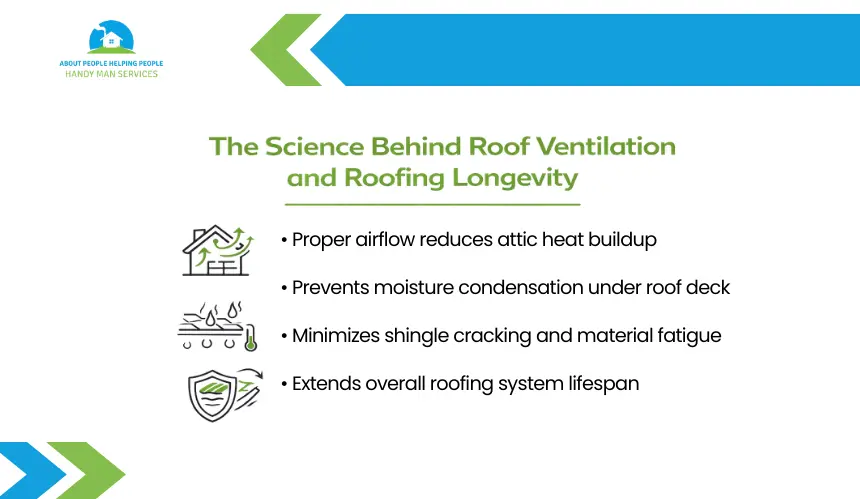
Proper roof ventilation is not simply about adding vents. It is about creating a controlled airflow system that regulates attic temperature and moisture levels year-round. A roofing system functions as an integrated structure. When attic air becomes stagnant, both thermal stress and condensation begin to degrade materials beneath the surface.
Understanding how ventilation interacts with heat and humidity explains why it directly influences roof lifespan.
How Airflow Regulates Attic Temperature
During summer, solar radiation heats roofing materials. Without adequate ventilation, that heat transfers into the attic and becomes trapped beneath the roof decking.
Did You Know? Unventilated attics can reach temperatures exceeding 150°F (65°C). Properly ventilated attics typically remain 30–50°F cooler, significantly reducing thermal stress on shingles.
Excess heat accelerates:
- Asphalt oxidation
- Granule loss
- Shingle brittleness
- Adhesive strip weakening
When shingles repeatedly expand and contract under extreme heat, their flexibility decreases. This leads to cracking, curling, and early failure. Heat buildup essentially compresses decades of aging into a much shorter period.
How Ventilation Removes Moisture Before It Causes Structural Damage
Moisture control is equally critical. Everyday activities such as cooking, showering, and laundry release water vapor into the home. Warm air naturally rises into the attic through ceiling penetrations, light fixtures, and duct gaps.
When this humid air contacts cooler roof sheathing, condensation forms.
Important Note: Condensation in an attic can occur even without a roof leak. It is often mistaken for exterior water intrusion.
Over time, condensation leads to:
- Dark staining and deterioration of the roof sheathing
- Corrosion of nail heads and fasteners
- Delamination of plywood decking
- Mold colonization on wood surfaces
Moisture buildup does not just threaten shingles. It compromises the structural foundation that supports the roofing system.
Why Temperature Stability Protects Flashing and Sealants
Roof systems expand during the day and contract at night. When ventilation is insufficient, temperature swings become more extreme. This intensified thermal cycling places strain on:
- Metal flashing at chimneys and valleys
- Sealants around penetrations
- Fastener connections
Repeated expansion and contraction weaken joint integrity. Small gaps begin forming around flashing edges and sealed seams, increasing the risk of water intrusion.
Technical Insight:
Even minor daily thermal movement, when amplified by trapped attic heat, can accelerate seal failure and shorten the lifespan of roofing components designed to withstand controlled expansion.
By maintaining consistent airflow, proper ventilation reduces temperature extremes, minimizes material fatigue, and preserves the integrity of critical connection points throughout the roofing system.
Why Ventilation and Insulation Are Not the Same System
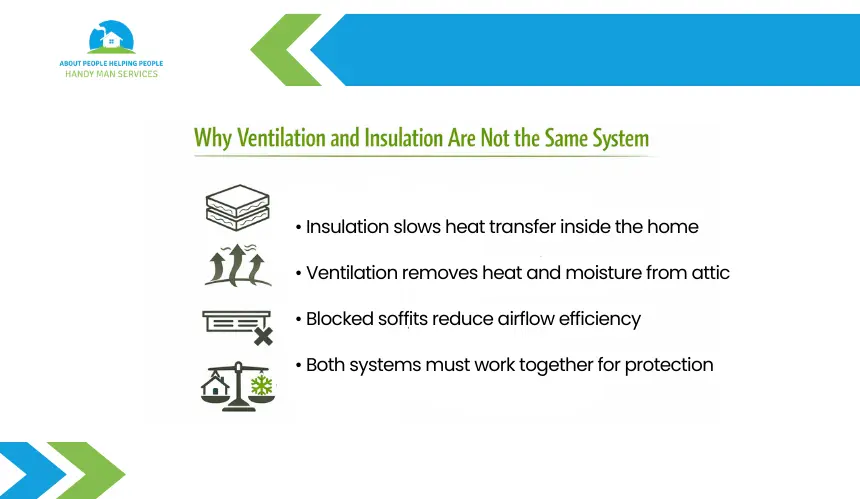
One of the most common misconceptions in roofing performance is the belief that adding more insulation solves ventilation problems. Insulation and ventilation serve different mechanical purposes. When these systems are misunderstood or improperly integrated, attic conditions can worsen rather than improve.
Understanding what each system controls is essential for protecting roofing longevity.
What Insulation Controls vs What Ventilation Controls
Insulation slows the transfer of heat between living spaces and the attic. It works by resisting the flow of conductive heat, typically measured in R-value units. A higher R-value means slower heat movement.
However, insulation does not:
- Remove trapped attic heat
- Eliminate moisture vapor
- Circulate stagnant air
Ventilation, by contrast, controls airflow. It creates a pathway for cool air to enter at the soffits and warm air to exit near the ridge. This continuous air exchange regulates attic temperature and carries moisture out before it condenses.
Important Distinction: Insulation traps heat. Ventilation removes heat. These functions are complementary, not interchangeable.
Why Insulation Alone Cannot Prevent Heat Buildup or Condensation
In some homes, additional insulation is installed without protecting intake vents. This often leads to blocked soffits, where insulation physically covers airflow openings at the eaves.
When soffit vents are blocked:
- Intake airflow is restricted
- Heat accumulates beneath the roof deck
- Moisture becomes trapped above the insulation layer
Missing or crushed baffles create a similar problem. Baffles are designed to maintain an open air channel between the insulation and the roof sheathing. Without them, the insulation presses against the decking, eliminating the airflow pathway.
Did You Know?
Improper insulation placement that blocks soffits can reduce ventilation efficiency by more than 50%, even if ridge vents are present.
In these conditions, moisture vapor rising from the home cannot escape. Condensation forms on the underside of the sheathing and around fasteners, accelerating wood rot and corrosion.
The Hidden Risk of Airflow Imbalance
Even with vents in place, the system may still fail if intake and exhaust are not properly balanced. If exhaust capacity exceeds intake capacity, the attic may draw conditioned air from the home rather than pulling fresh air from the soffits.
This imbalance can:
- Increase energy loss
- Create negative pressure zones
- Reduce overall ventilation performance
Ventilation must function as a balanced system. Insulation enhances interior comfort, but only proper airflow protects the structural components of the roofing assembly.
When ventilation and insulation are properly designed to work together, attic environments remain stable, moisture levels are controlled, and roofing materials age at their intended rate rather than deteriorate prematurely.
How Poor Ventilation Accelerates Roofing System Failure
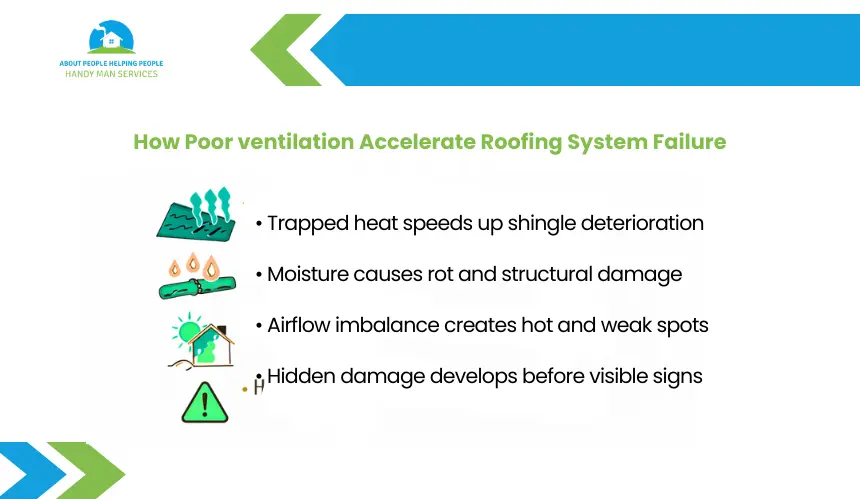
When airflow is restricted or unbalanced, the roofing system begins deteriorating from below. The damage often develops slowly and invisibly, which is why ventilation issues are frequently overlooked until structural repairs become necessary.
Roof lifespan reduction is rarely caused by one dramatic event. It is typically the result of repeated thermal stress and chronic moisture exposure.
Heat Buildup and Premature Aging of Roofing Materials
Excess attic heat directly impacts asphalt-based roofing materials. When temperatures remain elevated for extended periods, shingles experience accelerated oxidation.
Technical Fact: Asphalt shingles are engineered to perform within specific temperature ranges. Sustained attic heat can raise shingle surface temperatures well beyond ambient outdoor conditions, intensifying chemical breakdown.
The result includes:
- Loss of flexibility
- Granule shedding
- Blistering
- Adhesive strip weakening
Over time, this causes shingles to curl or crack prematurely. In extreme cases, manufacturers may void warranties if inadequate ventilation is found to be a contributing factor.
Heat buildup effectively shortens the aging timeline of the roofing system by amplifying daily expansion and contraction cycles.
Moisture Buildup and Hidden Structural Rot
Moisture is often the more destructive force because it compromises structural integrity beneath the visible roof surface.
When ventilation fails to remove humid air:
- Condensation forms on the underside of roof sheathing
- Fasteners begin to rust
- Plywood decking weakens
- Wood fibers start to decay
Important Note: Moisture-related deterioration can reduce the load-bearing strength of roof decking over time, even if the shingles above appear intact.
Mold growth may also develop on sheathing and framing members, posing indoor air quality concerns and requiring costly remediation.
Airflow Imbalance That Shortens Roof Life
Ventilation must operate as a continuous system from intake to exhaust. When intake vents are too small relative to exhaust capacity, the system cannot function efficiently.
In these cases:
- The attic may pull conditioned air from the home instead of drawing fresh outside air
- Hot spots develop beneath sections of the decking
- Moisture removal becomes inconsistent
Mixing different vent types improperly can also “short-circuit” airflow. For example, combining ridge vents with gable vents without proper design may cause air to exit prematurely before circulating through the entire attic space.
Ridge vent performance can also decline due to poor installation, insufficient ridge opening width, or compressed vent materials that restrict airflow.
Did You Know? Even a properly installed ridge vent can underperform if the intake area at the soffits does not meet the required net free vent area ratios.
When airflow becomes fragmented or imbalanced, heat and moisture concentrate in localized areas. These stress points accelerate shingle degradation, weaken structural components, and reduce the overall service life of the roofing system.
Proper ventilation prevents this compounding cycle by maintaining consistent air movement across the entire attic assembly.
How Balanced Ventilation Extends Real-World Roof Lifespan
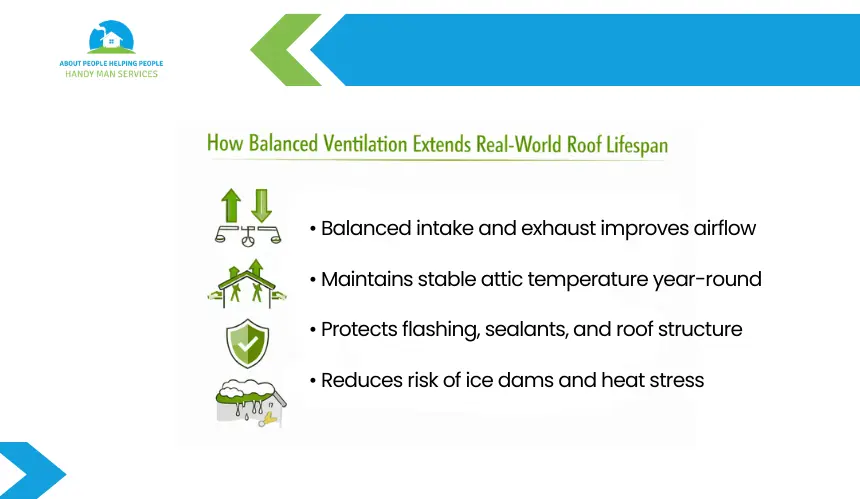
Balanced ventilation does more than improve airflow. It stabilizes the entire roofing assembly by keeping temperature and moisture levels within controlled limits. When intake and exhaust are properly calculated and installed, roofing materials age at their intended rate rather than deteriorating prematurely.
The goal is not simply to “add vents.” It is to design a system that maintains continuous, evenly distributed airflow.
Maintaining Proper Intake-to-Exhaust Ratios
Ventilation performance depends on the ratio between intake vents at the soffits and exhaust vents near the ridge.
Technical Standard: Building codes often reference the 1:150 rule, which requires one square foot of net free vent area (NFVA) for every 150 square feet of attic space. In some cases, with balanced intake and exhaust, the ratio may be reduced to 1:300.
If the intake is too small for the exhaust system:
- Air cannot enter efficiently
- Exhaust vents pull air from unintended sources
- Negative pressure may draw conditioned air from the home
If exhaust is insufficient:
- Heat and moisture accumulate at the roof peak
- Air stagnates beneath the decking
Balanced design ensures continuous airflow from eaves to ridge without pressure distortion.
Preserving Manufacturer Warranty Coverage
Many roofing manufacturers include ventilation requirements in their warranty terms. If ventilation does not meet specified NFVA guidelines, warranty claims for premature aging may be denied.
Important Note: Inadequate ventilation is one of the most common reasons shingle warranties are voided during inspections following early failure.
By maintaining balanced airflow, homeowners protect both the physical roofing system and the financial value of the manufacturer’s guarantee.
Preventing Ice Dams and Freeze-Thaw Stress
In colder climates, poor ventilation contributes to the formation of ice dams. When attic heat escapes unevenly, snow on the upper roof surface melts and refreezes at the colder eaves.
This cycle:
- Traps water beneath shingles
- Stresses flashing at valleys
- Forces moisture into underlayment layers
Consistent attic temperatures achieved through proper ventilation reduce uneven melting patterns and limit freeze-thaw damage.
Reducing Long-Term Energy and Structural Stress
Balanced ventilation also improves overall building performance. Lowering attic temperatures in summer reduces heat transfer into living spaces and decreases HVAC strain.
Over time, this contributes to:
- Lower cooling demand
- Reduced thermal stress on framing
- Stabilized attic humidity levels
When airflow is continuous and correctly proportioned, roofing components experience fewer extremes. The result is measurable lifespan extension, fewer repairs, and delayed roof-replacement timelines.
Proper ventilation does not merely support the roof. It safeguards the structural system beneath it and extends the functional life of the entire roofing assembly.
Long-Term Financial Impact of Proper Roof Ventilation
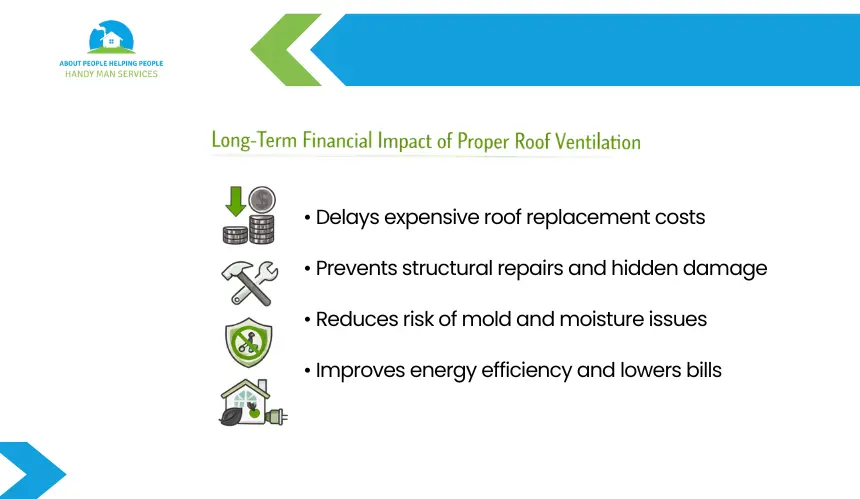
Roof ventilation is often viewed as a secondary design feature, yet its financial impact can be substantial over the life of a roofing system. When airflow is properly balanced, the return on investment extends beyond durability to reduced repair frequency and deferred replacement costs.
A roof rated for 25 to 30 years is engineered to perform under stable thermal and moisture conditions. When ventilation fails, that lifespan can be reduced significantly due to accelerated material fatigue and structural degradation.
Delaying Full Roof Replacement
Premature shingle aging, deck warping, and flashing separation often force early replacement. If excessive attic heat and moisture shorten lifespan by even 5 to 10 years, the financial loss is considerable.
Technical Insight: Replacing a roof even five years earlier than expected can increase lifecycle cost by 15 to 25 percent, depending on material and labor rates.
Proper ventilation helps roofing systems reach their designed service life rather than fail due to preventable internal stress.
Reducing Structural Repair Expenses
Moisture-related damage rarely stops at shingles. Condensation on sheathing can lead to plywood delamination, weakened rafters, and corrosion of fasteners.
Repairing structural components beneath the roofing surface often requires partial tear-offs, which increase labor and material costs.
By preventing moisture buildup and rot, ventilation reduces the likelihood of costly hidden structural repairs and the need for surface maintenance.
Avoiding Mold Remediation and Interior Damage
Chronic attic condensation creates favorable conditions for mold growth. Beyond structural concerns, mold remediation may involve removing insulation, applying chemical treatments, and testing air quality.
Important Note: Mold remediation costs can exceed the price of upgrading ventilation systems, particularly when contamination spreads beyond the attic.
Maintaining proper airflow helps minimize humidity accumulation and reduce biological growth risks.
Lowering Energy Consumption Over Time
Ventilated attics maintain more stable temperatures, reducing heat transfer into living spaces. In summer, lower attic temperatures mean less cooling demand. In winter, reduced moisture accumulation protects insulation performance.
Over years of operation, even moderate reductions in HVAC strain contribute to measurable energy savings.
Frequently Asked Questions
Does adding more insulation fix poor roof ventilation?
Adding insulation improves thermal resistance but does not remove trapped heat or moisture from the attic. In fact, improperly installed insulation can block soffit vents and worsen airflow problems. Ventilation controls air movement and vapor removal, while insulation slows heat transfer. Both systems must function together to protect the roofing structure.
How do you know if a roof has enough ventilation?
Adequate ventilation depends on net free vent area (NFVA) calculations based on attic square footage. Building codes commonly reference the 1:150 or 1:300 ratio when intake and exhaust are balanced. Signs of inadequate ventilation include excessive attic heat, condensation on sheathing, rusted fasteners, mold staining, and premature shingle deterioration.
Can too much ventilation damage a roofing system?
Excess ventilation is rarely the issue. Imbalanced ventilation is the real problem. If exhaust vents significantly exceed intake capacity, negative pressure can develop, drawing conditioned air from the home instead of fresh outdoor air. Proper design requires balanced intake and exhaust to maintain steady airflow without pressure distortion.
Is a ridge vent better than a powered attic fan?
Ridge vents provide continuous, passive airflow when paired with adequate soffit intake. Powered attic fans can increase airflow but may create pressure imbalances if intake is insufficient. In many cases, a properly balanced passive ridge and soffit system offers more consistent performance without mechanical dependency.
Does roof ventilation affect shingle warranty coverage?
Many manufacturers include ventilation requirements in their warranty terms. If inspection reveals inadequate airflow contributing to premature aging, warranty claims may be denied. Maintaining proper intake-to-exhaust ratios helps preserve both roof performance and warranty protection.
What is the difference between an electrician and an electrical contractor?
An electrician performs electrical installation and repair work. An electrical contractor typically manages larger projects, employs licensed electricians, handles permits, and oversees code compliance for residential or commercial construction projects.