
- About People Helping People
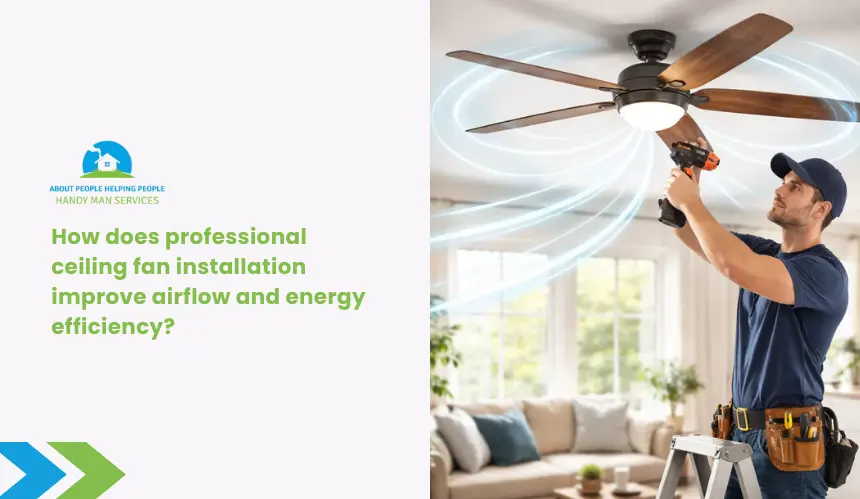
How does professional ceiling fan installation improve airflow and energy efficiency?
Quick Answer: Optimizes mounting height and placement to ensure maximum CFM output and balanced air distribution throughout the room.
|
A ceiling fan seems simple. It spins, moves air, and cools a room. Yet the difference between a poorly installed fan and a professionally installed one can significantly impact airflow performance and monthly energy bills.
Many homeowners install ceiling fans expecting immediate comfort improvements, only to notice uneven airflow, lingering hot spots, or minimal energy savings. The problem is rarely the fan itself. It is the installation. Mounting height, blade alignment, room positioning, and electrical stability all determine how effectively air circulates and how much strain is placed on the HVAC system.
When installed correctly, a ceiling fan does more than create a breeze. It enhances air distribution, supports thermostat efficiency, reduces cooling and heating loads, and improves long-term energy performance. Understanding how professional installation directly influences airflow mechanics and energy efficiency reveals why precision matters far more than most people realize.
How Does Professional Ceiling Fan Installation Directly Improve Airflow?
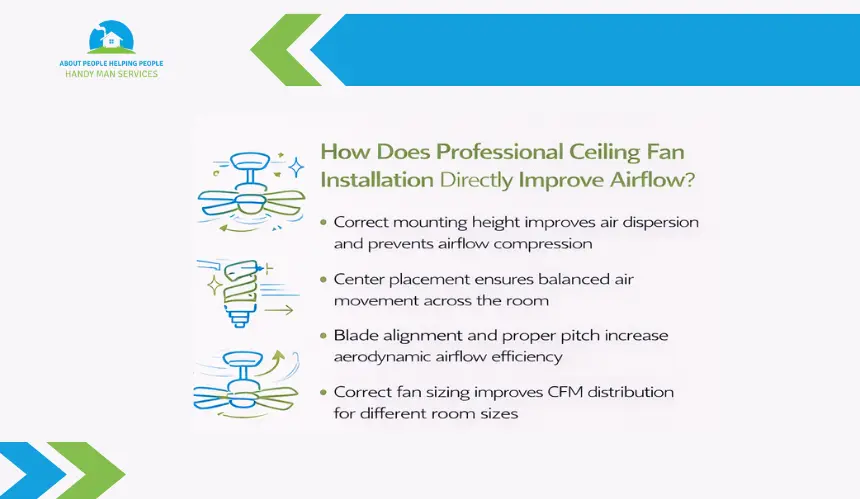
Professional ceiling fan installation improves airflow by optimizing measurable performance variables such as blade height, pitch alignment, rotational stability, and room positioning. Airflow efficiency is not just about the fan spinning. It is about maximizing CFM (Cubic Feet per Minute) output while maintaining balanced air distribution across the entire room.
When installation variables are precise, airflow becomes uniform, consistent, and energy-supportive rather than turbulent or localized.
How does correct mounting height maximize airflow performance?
Mounting height directly affects how air disperses. For ceilings eight feet high, blades should typically be positioned about 12 inches below the ceiling and 8–9 feet above the floor. If the fan is mounted too close to the ceiling, airflow becomes compressed and recirculates inefficiently. If installed too low, airflow concentrates vertically instead of spreading horizontally.
Did you know?
According to energy performance studies referenced by the U.S. Department of Energy, optimal fan height significantly improves air mixing efficiency, thereby enhancing perceived cooling without lowering the thermostat setting.
Professionals calculate proper downrod length based on ceiling height to prevent airflow dead zones and ceiling turbulence. This allows the fan to create a wider conical air pattern that distributes circulation evenly across the room.
Why does precise fan placement improve room-wide air distribution?
Center-of-room positioning ensures symmetrical air movement. When a fan is installed off-center or too close to walls and cabinets, airflow becomes uneven, leaving stagnant pockets of warm air.
Air movement is not just downward. It spreads outward, then circulates upward along the walls. Professionals evaluate room dimensions, square footage, and obstructions to maintain balanced airflow patterns.
Pro Tip:
Industry guidelines recommend a minimum of 18–24 inches of blade clearance from walls to prevent aerodynamic interference and maintain maximum CFM efficiency.
Improper placement can reduce effective airflow output by creating turbulence that weakens the fan’s ability to mix indoor air layers.
How does blade alignment and balancing enhance airflow efficiency?
Blade pitch typically ranges between 12 and 15 degrees. This angle determines how much air is displaced per rotation. Even small misalignments or warped blades reduce aerodynamic lift and create vibration.
Unbalanced fans not only wobble but also lose rotational consistency. That instability lowers effective RPM and reduces air displacement.
Did you know?
Energy Star–certified ceiling fans move more air per watt than conventional models, sometimes improving airflow efficiency by up to 60% when properly installed and balanced.
Professional installation includes:
- Securing the fan to a UL-rated, load-bearing electrical box
- Calibrating blade alignment
- Testing rotational stability
- Ensuring the motor housing is level
Balanced rotation reduces motor strain, lowers electrical waste, and maintains consistent airflow output over time.
Why does correct fan sizing impact airflow performance?
Airflow efficiency depends heavily on matching blade span to room size. A small fan in a large room cannot generate enough CFM to effectively circulate air. Conversely, an oversized fan in a small room can create excessive localized airflow without improving overall mixing.
General sizing guidance:
- Up to 75 sq. ft.: 29–36 inch blade span
- 75–144 sq. ft.: 36–42 inch blade span
- 144–225 sq. ft.: 44–50 inch blade span
- Over 225 sq. ft.: 52 inches or larger
Proper sizing ensures airflow spreads evenly across the space, maximizing air mixing rather than concentrating it in one area.
Why does motor type matter for airflow efficiency?
DC motor ceiling fans use significantly less electricity than traditional AC motor fans while maintaining consistent torque. Studies show that DC motor fans can consume up to 70% less energy while delivering higher airflow-to-watt ratios.
When installed correctly, DC motors maintain steady RPM under load, ensuring consistent air displacement and improved circulation stability.
How Does Improved Airflow Translate Into Energy Efficiency?
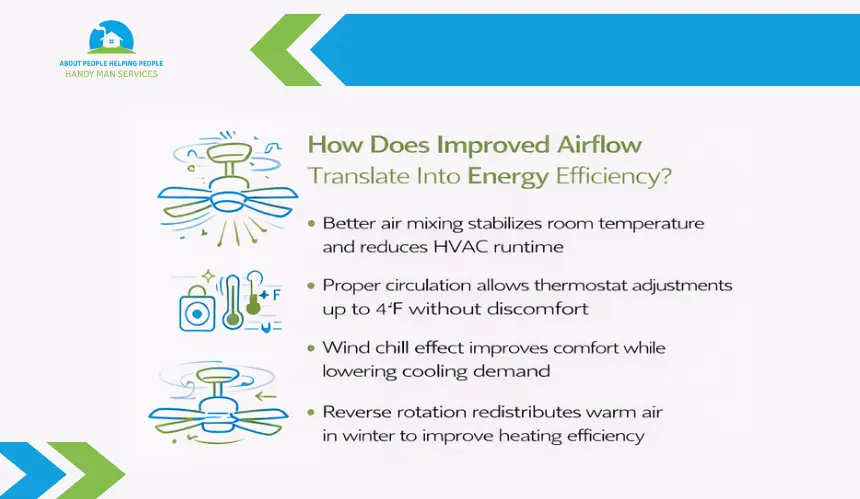
Improved airflow is not just about comfort. It directly influences how hard an HVAC system works, how often it cycles, and how much electricity a household consumes. When professional ceiling fan installation maximizes CFM output and air distribution, the resulting circulation reduces thermal imbalance, allowing heating and cooling systems to operate more efficiently.
The connection is simple but powerful:
Better air mixing → More stable room temperature → Reduced HVAC runtime → Lower energy consumption.
How does increased air circulation reduce HVAC workload?
When air circulates evenly, hot and cold pockets disappear. Without proper airflow, thermostats detect uneven temperatures and trigger longer cooling or heating cycles. This increases compressor strain and energy usage.
According to the U.S. Department of Energy, proper air circulation allows homeowners to adjust the thermostat by about 4°F without reducing comfort. That shift alone can significantly reduce cooling demand during peak summer months.
Did you know?
Air conditioners account for roughly 12% of total household electricity use in the United States. Even small reductions in runtime can create noticeable annual savings.
By improving airflow distribution, a professionally installed ceiling fan reduces the frequency and duration of HVAC cycles, lowering compressor workload and extending equipment lifespan.
How does the wind chill effect enable thermostat adjustments?
Ceiling fans do not lower the actual air temperature. Instead, they create a wind chill effect that increases evaporative cooling on the skin. This makes occupants feel cooler even if the thermostat setting remains higher.
When airflow is optimized:
- Occupants remain comfortable at higher thermostat settings
- Cooling demand decreases
- Peak energy consumption is reduced
Pro Tip: Raising the thermostat by 3–4°F while using a properly installed ceiling fan can reduce cooling costs by 10–15%, depending on climate and insulation conditions.
The key is consistent airflow. If installation is incorrect, the breeze becomes uneven and ineffective, limiting perceived comfort and reducing potential savings.
How does reverse rotation improve heating efficiency in winter?
Warm air naturally rises and accumulates near the ceiling. Without circulation, this heat remains trapped, forcing furnaces to work harder to maintain comfort at the occupant level.
Professional installation ensures correct blade alignment and motor calibration, enabling the fan to operate efficiently in reverse (clockwise) mode during winter. This gently pushes warm air downward without creating a cooling draft.
Did you know?
Heat stratification in rooms with standard 8-foot ceilings can create temperature differences of 5–10°F between the ceiling and the floor. In higher ceilings, that difference can be even greater.
By redistributing trapped warm air, ceiling fans reduce furnace load and improve overall heating efficiency.
How do energy-efficient motors enhance long-term savings?
Motor design plays a critical role in energy translation. DC motor ceiling fans consume significantly less electricity while maintaining consistent torque and airflow output.
Energy Star–certified fans are engineered to deliver higher airflow per watt. This airflow-to-watt ratio determines how efficiently electrical energy converts into usable air movement.
When professionally installed:
- Voltage stability is maintained
- Motor vibration is minimized
- Electrical losses are reduced
These factors ensure the fan operates at peak efficiency, maximizing comfort while minimizing electrical consumption.
The Bigger Efficiency Picture
Professional ceiling fan installation improves airflow precision. That improved airflow reduces HVAC strain, supports thermostat optimization, decreases cooling and heating demand, and lowers total household energy consumption.
In other words, airflow optimization is not a minor comfort upgrade. It is a practical energy management strategy.
Why Does Professional Installation Matter More Than DIY for Efficiency?
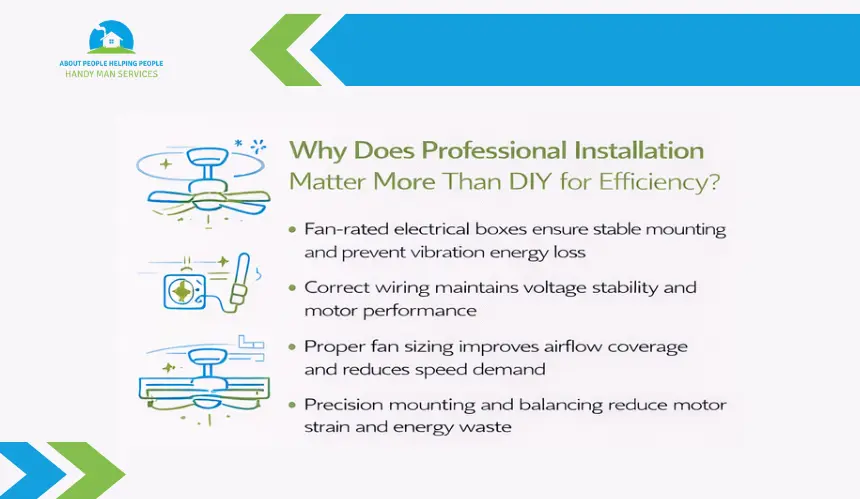
A ceiling fan may appear straightforward to install, but small installation errors can significantly reduce airflow performance and energy efficiency. Professional installation ensures structural stability, electrical integrity, proper sizing, and calibrated alignment, all of which directly affect how efficiently the fan converts electrical energy into usable airflow.
Efficiency is not just about the fan model. It is about how precisely it is installed.
How does proper electrical support prevent energy waste?
Ceiling fans must be mounted to a UL-rated, load-bearing electrical box specifically designed to support rotational movement. Standard light fixture boxes are not engineered to withstand continuous dynamic force.
Improper mounting can lead to:
- Vibration and wobble
- Motor misalignment
- Increased friction
- Reduced RPM stability
When a fan vibrates excessively, energy is lost through mechanical instability rather than being converted into airflow.
Did you know?
The National Electrical Code (NEC) requires ceiling fans to be supported independently of the outlet box unless the box is specifically listed for fan support. Non-compliant installations increase both safety risks and efficiency losses.
Professionals secure the mounting bracket directly to ceiling joists or approved support braces, ensuring stable rotational performance and minimizing electrical waste.
How does correct wiring configuration improve motor performance?
Voltage stability plays a critical role in motor efficiency. Loose connections, incorrect switch wiring, or shared overloaded circuits can reduce motor output and increase energy draw.
Professional installation ensures:
- Proper grounding
- Correct amperage compatibility
- Dedicated circuit evaluation
- Secure wire terminations
Pro Tip: Even minor voltage drops can cause motors to work harder to maintain speed, increasing wattage consumption over time.
By ensuring proper electrical configuration, professionals help maintain consistent airflow-to-watt efficiency.
How do professionals size the fan correctly for the room?
One of the most overlooked efficiency factors is the blade span relative to the room’s square footage. An undersized fan must operate at higher speeds to compensate for inadequate CFM output. An oversized fan may create excessive localized airflow without improving overall air mixing.
Proper fan sizing improves:
- Uniform circulation
- Reduced speed demand
- Balanced energy use
Did you know?
Ceiling fan efficiency is measured by the airflow-to-watt ratio. A correctly sized fan operating at moderate speed often delivers better energy performance than an undersized fan running continuously at maximum speed.
Professionals assess:
- Room dimensions
- Ceiling height
- Air volume (cubic feet)
- Layout and obstructions
This ensures airflow is distributed efficiently rather than concentrated unevenly.
How does precision installation extend motor lifespan?
Motor strain increases when fans are improperly balanced or poorly mounted. Continuous wobble forces the motor to compensate, accelerating bearing wear and increasing electrical resistance.
Professional calibration reduces:
- Mechanical stress
- Heat buildup
- Energy inefficiencies
- Maintenance frequency
Lower motor strain translates into long-term performance stability and reduced energy waste throughout the fan’s life.
What Energy-Efficient Technologies Perform Best When Installed Professionally?
Energy efficiency is not determined solely by installation. It is also influenced by the technology built into the ceiling fan. However, even the most advanced features underperform if installation precision is lacking. Professional setup ensures these technologies operate at their full airflow-to-watt potential.
When advanced fan systems are correctly mounted, balanced, and wired, they deliver measurable efficiency gains rather than theoretical ones.
Why are DC motor ceiling fans significantly more efficient?
DC (direct current) motors are engineered to consume far less electricity than traditional AC motors while maintaining consistent torque and airflow output. They generate less internal heat and operate with smoother rotational control.
Did you know?
DC motor ceiling fans can use up to 70% less energy than conventional AC motor models while delivering equal or higher CFM performance.
Because DC motors are more sensitive to voltage irregularities, professional wiring and stable mounting are critical. Improper installation can negate efficiency advantages by causing inconsistent speed regulation or electrical strain.
When properly installed, DC fans offer:
- Higher airflow-to-watt ratios
- Quieter operation
- Reduced energy consumption at lower speeds
- Extended motor lifespan
How do Energy Star–certified ceiling fans enhance airflow efficiency?
Energy Star–certified ceiling fans are tested against performance standards that measure airflow relative to energy use. The key metric is airflow efficiency, expressed as CFM per watt.
Did you know? Energy Star ceiling fans are, on average, up to 60% more efficient than standard models.
Professional installation ensures:
- Correct blade pitch alignment
- Secure motor housing
- Optimal mounting height
These factors protect the certified efficiency rating by preventing airflow disruption or mechanical energy loss.
How does smart fan integration improve energy management?
Modern ceiling fans increasingly integrate with smart thermostats and home automation systems. When synchronized properly, fans adjust speed automatically based on occupancy, temperature, or time of day.
Professionally installed smart ceiling fans can:
- Coordinate with HVAC systems
- Operate only when rooms are occupied
- Shift speeds seasonally
- Reduce unnecessary runtime
Pro Tip: Pairing a smart ceiling fan with a programmable thermostat amplifies energy savings because airflow and temperature adjustments work together rather than independently.
Incorrect installation can interfere with wireless connectivity, voltage stability, or sensor calibration. Professional configuration ensures that automation enhances efficiency instead of creating operational inconsistencies.
How does the airflow-to-watt ratio determine true efficiency?
Energy efficiency is not just about low wattage. It is about how effectively electrical input converts into usable airflow. The airflow-to-watt ratio determines how many cubic feet of air are moved per unit of electricity consumed.
When installation is precise:
- Motor alignment reduces friction
- Balanced blades maintain steady RPM
- Electrical connections minimize power loss
These factors protect and maximize the fan’s engineered airflow efficiency.
What Installation Errors Reduce Airflow and Increase Energy Costs?
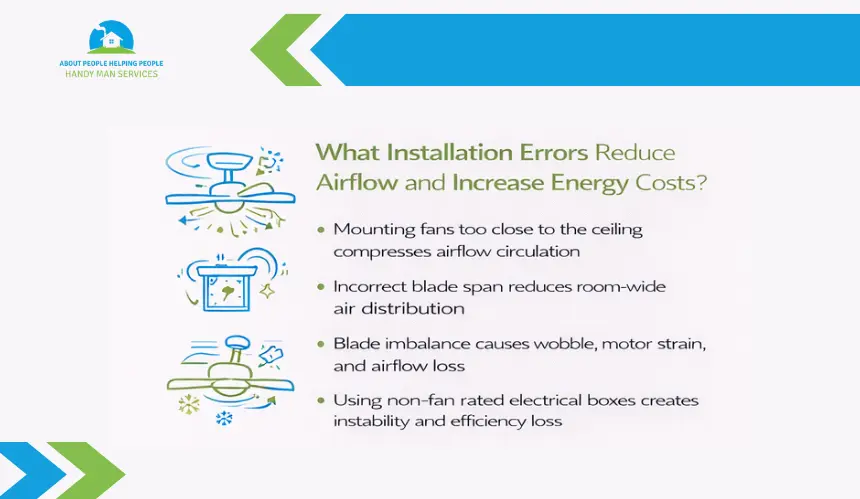
Ceiling fans are engineered to improve airflow efficiency, but improper installation can significantly limit their performance. Small positioning or wiring mistakes often go unnoticed at first, yet they directly reduce CFM output, increase motor strain, and limit the energy-saving benefits that ceiling fans are designed to provide.
Understanding these common errors reinforces why professional installation plays such a critical role in maximizing airflow and efficiency.
Installing the fan too close to the ceiling
When blades are mounted too close to the ceiling, airflow becomes compressed and recirculates inefficiently. Instead of spreading outward and downward, air gets trapped in a turbulence zone, reducing effective circulation.
For standard ceilings, blades should typically sit about 8–9 feet above the floor and 10–12 inches below the ceiling.
Did you know? Research on air circulation patterns shows that insufficient ceiling clearance reduces the fan’s ability to evenly mix room air, limiting perceived cooling benefits even at higher fan speeds.
This forces occupants to unnecessarily lower thermostat settings, increasing energy consumption.
Choosing the wrong blade span for the room size
Fan sizing directly affects airflow coverage. An undersized fan in a large room produces insufficient CFM to evenly circulate air, while an oversized fan in a small room may create concentrated airflow without improving overall mixing.
Improper sizing leads to:
- Higher speed operation to compensate
- Increased electrical draw
- Uneven temperature distribution
Pro Tip: Always match blade span to square footage. Correct sizing allows moderate speeds to deliver sufficient airflow, reducing unnecessary energy use.
Ignoring blade balance and alignment
Even a slight blade imbalance causes wobbling, reducing aerodynamic efficiency and increasing motor resistance. The motor must work harder to maintain rotational speed, resulting in higher wattage consumption.
Over time, imbalance contributes to:
- Bearing wear
- Heat buildup
- Reduced lifespan
- Decreased airflow consistency
Balanced rotation ensures consistent RPM and maximizes airflow displacement per rotation.
Using a standard electrical box instead of a fan-rated box
Ceiling fans generate continuous rotational force. A standard light fixture box is not designed to withstand this dynamic load.
Improper support can cause:
- Mounting instability
- Vibration energy loss
- Electrical stress
- Safety hazards
The National Electrical Code requires ceiling fans to be supported by a fan-rated box or independent structural support. Professional installers secure mounting brackets to joists or approved braces to prevent performance loss and safety risks.
Overlooking seasonal direction settings
Ceiling fans operate differently in summer and winter. Running the fan counterclockwise in summer creates a downward airflow for cooling. Clockwise rotation in winter redistributes trapped warm air near the ceiling.
Failure to adjust seasonal rotation reduces energy efficiency and limits the fan’s ability to support HVAC performance.
Did you know?
Heat stratification can create temperature differences of several degrees between floor and ceiling levels. Proper seasonal adjustment improves air mixing and reduces heating demand.
What Is the Long-Term Energy and Cost Impact of Professional Installation?
Professional ceiling fan installation does not just improve immediate airflow performance. It creates measurable long-term energy savings, reduces HVAC strain, and protects both the fan motor and the home’s electrical system. When airflow efficiency is optimized from the beginning, energy savings compound over time.
The impact becomes clearer when viewed through the lens of operating costs, equipment longevity, and system efficiency.
How much can improved airflow reduce cooling costs over time?
Ceiling fans allow homeowners to raise thermostat settings by approximately 3–4°F without sacrificing comfort. According to the U.S. Department of Energy, adjusting the thermostat upward during cooling season can significantly reduce air conditioning demand.
Did you know?
Air conditioning accounts for about 12% of total household electricity consumption in the United States. In warmer regions, that percentage can be much higher during peak summer months.
By reducing compressor runtime and cycling frequency, a properly installed ceiling fan lowers peak cooling loads. Even a modest 10–15% reduction in cooling demand over a season can translate into noticeable annual savings.
Because ceiling fans typically consume between 15 and 90 watts, depending on speed and motor type, they use far less energy than central air systems, which can draw thousands of watts during operation.
How does airflow optimization extend HVAC lifespan?
When airflow is uneven, HVAC systems compensate by running longer cycles. Continuous cycling increases wear on:
- Compressors
- Blower motors
- Capacitors
- Furnace heat exchangers
Professional ceiling fan installation improves air mixing and temperature consistency, reducing unnecessary strain on these components.
Pro Tip: Reduced HVAC runtime not only saves energy but can delay costly system repairs and replacements, improving overall return on investment.
Less mechanical stress leads to longer equipment lifespan and fewer maintenance interventions.
How does professional installation protect the ceiling fan’s lifespan?
Balanced mounting, correct electrical support, and stable wiring reduce motor stress and internal heat buildup. Over time, these factors directly influence durability.
Improper installation often leads to:
- Premature bearing wear
- Increased electrical resistance
- Excessive vibration damage
A professionally installed fan maintains smoother operation, consistent RPM, and efficient energy conversion throughout its service life.
What is the overall return on investment?
The return on investment comes from multiple efficiency layers working together:
- Reduced cooling and heating demand
- Lower HVAC repair frequency
- Extended fan motor lifespan
- Improved airflow-to-watt efficiency
While installation has an upfront cost, long-term energy savings and reduced mechanical wear often offset that investment over time.
Professional installation transforms the ceiling fan from a decorative fixture into a practical energy management tool.
Final Insight
When airflow is optimized, HVAC systems operate more efficiently, energy consumption decreases, and mechanical systems experience less strain. Professional ceiling fan installation delivers long-term financial value by aligning airflow performance with energy efficiency, safety compliance, and system longevity.
Frequently Asked Questions
How much energy does a ceiling fan actually use compared to an air conditioner?
A ceiling fan typically consumes between 15 and 90 watts, depending on speed and motor type, while a central air conditioning system can draw 2,000 to 5,000 watts during operation. Because fans use significantly less electricity, they offer a cost-effective way to improve comfort while reducing HVAC runtime.
What size ceiling fan provides the best airflow for a room?
The ideal blade span depends on the room’s square footage. Smaller rooms under 75 square feet generally require a 29–36-inch fan, while larger spaces over 225 square feet perform best with 52-inch or larger models. Correct sizing ensures adequate CFM output without unnecessary energy consumption.
Does a ceiling fan lower the actual room temperature?
A ceiling fan does not reduce the measured air temperature. Instead, it creates a wind chill effect that enhances evaporative cooling on the skin. This improves perceived comfort, allowing thermostat settings to be raised without sacrificing indoor comfort levels.
How should a ceiling fan rotate in summer and winter?
In summer, the fan should rotate counterclockwise to push air downward and create a cooling breeze. In winter, clockwise rotation at low speed redistributes warm air trapped near the ceiling without creating a draft, improving heating efficiency.
Can improper installation reduce a ceiling fan’s efficiency?
Yes. Incorrect mounting height, poor blade balance, improper electrical support, or wrong fan sizing can reduce airflow performance and increase motor strain. These issues limit CFM output and reduce the ceiling fans’ energy-saving benefits.
Are DC motor ceiling fans worth the investment?
DC motor ceiling fans are generally more energy efficient than traditional AC motor models. They consume significantly less electricity, operate more quietly, and offer improved airflow-to-watt ratios. When professionally installed, they deliver long-term energy savings and consistent airflow performance.