

- About People Helping People
How Does Outdoor Lighting Improve Home Safety And Nighttime Visibility?
Quick Answer: Outdoor lighting improves home safety and nighttime visibility by increasing illumination levels, reducing shadows, and controlling how light is distributed across critical areas. This allows people to move safely, identify hazards, and detect unusual activity in low-light conditions. From a technical standpoint, outdoor lighting enhances safety through three core mechanisms:
Outdoor lighting also contributes to security by deterring unauthorized activity. Well-lit environments reduce concealment opportunities and increase the likelihood of detection, especially when combined with motion-activated systems. Did you know? Areas with consistent outdoor lighting tend to have a lower risk of accidents and improved visibility for residents and visitors at night. In addition, outdoor lighting supports:
In practical terms, outdoor lighting serves as a visibility and safety control system, improving awareness, reducing environmental risks, and enhancing overall security at night. |
Darkness reduces the ability to detect hazards, judge distances, and respond to movement. Around a home, this creates multiple safety risks that are not always obvious during daylight hours. Areas such as walkways, driveways, stairs, and entry points can become difficult to navigate when illumination is insufficient.
Low-light conditions affect how the human eye processes information. Depth perception weakens, contrast decreases, and objects blend into the background. This makes it harder to identify obstacles, uneven surfaces, or changes in elevation, increasing the likelihood of trips, slips, and navigation errors.
Did you know? The human eye requires significantly more light to distinguish edges and movement at night, which is why poorly lit areas feel more disorienting.
In addition to physical safety risks, darkness also creates security concerns. Unlit areas provide concealment, making unauthorized activity go unnoticed. Limited visibility reduces awareness of surroundings, which can delay reaction time in unexpected situations.
Outdoor lighting addresses these challenges by restoring visibility, improving spatial awareness, and reducing uncertainty in low-light environments. Without it, even familiar spaces can become unpredictable and potentially unsafe after dark.
How Does Outdoor Lighting Improve Visibility At Night?
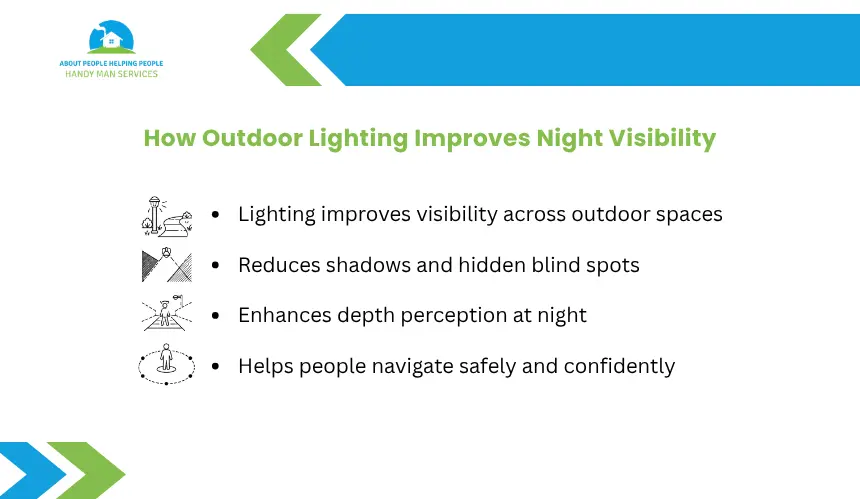
Outdoor lighting improves nighttime visibility by increasing luminance levels, controlling shadow formation, and enhancing contrast, allowing the human eye to interpret surroundings more accurately. This directly reduces navigation errors and improves situational awareness.
Illuminating Pathways And Walkways
Pathways and walkways are primary movement areas where visibility is critical. Without adequate lighting, small obstacles such as uneven surfaces, debris, or elevation changes can go unnoticed.
Proper illumination along these routes creates a continuous visual guide, helping individuals move confidently and safely. Consistent lighting reduces uncertainty and ensures that the path remains clearly defined from one point to another.
Did you know? Even low-level pathway lighting can significantly improve navigation by outlining walking routes and reducing visual confusion.
Reducing Shadows And Blind Spots
Shadows are a major cause of poor visibility at night. When light is unevenly distributed, it creates dark zones where objects or movement cannot be easily detected.
Strategic lighting placement minimizes these shadowed areas by spreading illumination across surfaces and eliminating blind spots. This ensures that critical areas remain visible and reduces the risk of hidden hazards.
Enhancing Depth Perception And Spatial Awareness
Depth perception relies on contrast and variations in light. In low-light conditions, the eye struggles to distinguish distances and shapes, making it difficult to judge steps, slopes, or the placement of objects.
Balanced outdoor lighting improves contrast between surfaces, allowing the eye to interpret spatial relationships more effectively. This enhances the ability to detect elevation changes and navigate complex areas with greater accuracy.
How Does Outdoor Lighting Improve Home Security?
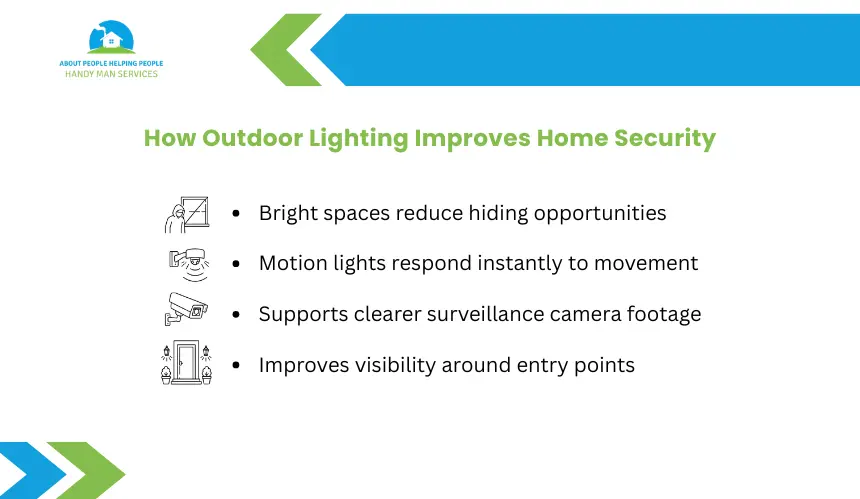
Outdoor lighting improves home security by reducing concealment, increasing visibility of movement, and enabling faster detection of unusual activity. When areas around a home are properly illuminated, it becomes more difficult for unauthorized individuals to approach or remain unnoticed.
Deterring Intruders
Well-lit environments act as a deterrent because they reduce the ability to hide. Intruders typically rely on darkness to approach entry points without being seen. When lighting is present, visibility increases, and the likelihood of detection increases.
This changes the risk factor. A property with consistent lighting appears more secure and less accessible compared to one with dark or shadowed areas.
Did you know? Visible lighting around entry points and perimeters can significantly reduce opportunities for concealment.
Motion Sensor Activation
Motion-activated lighting adds an additional layer of security by responding instantly to movement. When motion is detected, lights turn on, drawing attention to the area and disrupting any attempt to remain unnoticed.
This sudden illumination serves two purposes. It alerts occupants to activity and increases the visibility of the individual triggering the sensor. This makes it harder for unauthorized movement to go undetected.
Supporting Surveillance Systems
Outdoor lighting enhances the effectiveness of cameras and monitoring systems. Surveillance devices rely on adequate lighting to capture clear images and accurately detect movement.
Without proper illumination, camera visibility is limited, reducing image clarity and detection accuracy. When lighting is properly positioned, it improves coverage and ensures that monitored areas remain visible at all times.
What Areas Of A Home Need Lighting For Maximum Safety?
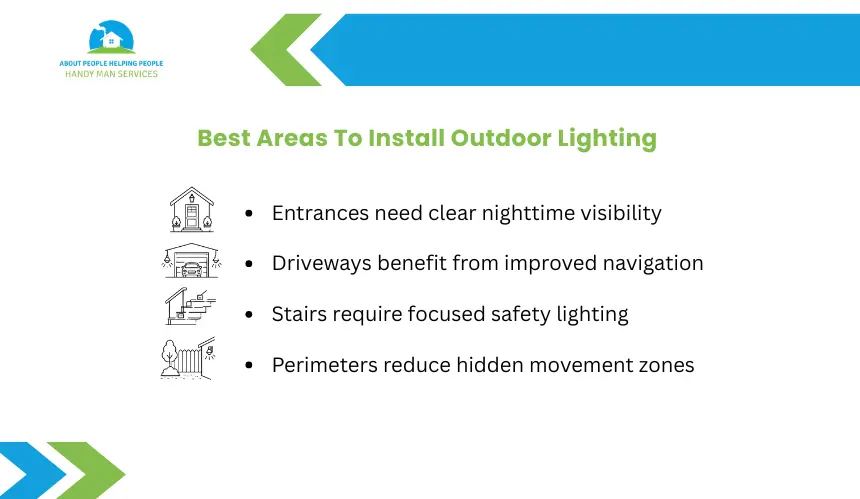
Outdoor lighting is most effective in high-risk, high-traffic areas where visibility directly impacts safety and security. These zones are where movement occurs, hazards exist, or access points are located. Proper illumination in these areas reduces accidents and improves the detection of activity.
Entrances and Doorways
Entry points such as front doors, back doors, and side entrances require consistent lighting because they are primary access locations. Poor visibility at these points increases the risk of missteps, difficulty using locks, and delayed response to visitors or unexpected activity.
Well-lit entrances improve both safety and security by ensuring clear visibility of who is approaching and what is happening at the access point.
Did you know? A 2025 home safety study found that properly illuminated entry points can significantly improve visibility and response time during nighttime activity.
Driveways and Garages
Driveways are transitional areas where both pedestrians and vehicles operate. Low visibility can lead to navigation errors, misjudged distances, or obstacles going unnoticed.
Lighting in these areas helps define boundaries, improves vehicle alignment, and reduces the likelihood of accidents. It also increases awareness of movement around parked vehicles and garage access points.
Did you know? Improved driveway lighting has been shown to reduce nighttime navigation errors and minor accidents in residential settings.
Stairs and Uneven Surfaces
Stairs, slopes, and uneven ground present one of the highest safety risks at night. Without proper illumination, changes in elevation become difficult to detect, increasing the chance of trips and falls.
Focused lighting in these areas improves edge visibility and depth perception, allowing users to clearly identify each step and move safely.
Backyard and Perimeter Areas
Perimeter spaces and backyards are often less visible but still frequently used. These areas can contain obstacles, landscaping features, or open spaces that become hazardous in low light.
Lighting improves situational awareness and reduces blind spots. It also increases security by ensuring that movement around the property is visible from inside the home.
Did you know? Studies on residential lighting indicate that well-lit perimeters improve visibility coverage and reduce the number of undetected movement zones around a property.
What Types Of Outdoor Lighting Are Best For Safety?
Different lighting types serve different safety functions. The effectiveness of outdoor lighting depends on selecting the right type for each area based on coverage, intensity, response behavior, and energy efficiency. A combination of lighting types usually provides the most complete protection.
Motion Sensor Lights
Motion sensor lights activate when movement is detected, providing immediate illumination only when needed. This makes them highly effective for security because they respond dynamically to activity.
They are commonly used near entrances, driveways, and side areas where unexpected movement may occur. The sudden activation draws attention and increases visibility instantly.
Did you know? Motion-activated lighting has been shown to significantly improve the detection of movement compared to constant low-level lighting.
Floodlights
Floodlights provide wide-area illumination with high intensity. They are designed to cover large spaces such as backyards, driveways, and building perimeters.
Their strength lies in reducing dark zones and increasing overall visibility across broad areas. When positioned correctly, they eliminate shadows and improve the line of sight across the property.
Pathway Lighting
Pathway lights are low-intensity fixtures installed along walkways and paths of movement. Their purpose is not to flood an area with light but to define direction and improve navigation.
By outlining paths, they help individuals maintain orientation and reduce the likelihood of stepping into unlit or unsafe areas.
Wall-Mounted Lighting
Wall-mounted fixtures are typically installed near doors, garages, and exterior walls. They provide focused illumination at key access points, improving visibility at entry and exit.
These lights also support identification, making it easier to see faces, objects, or activity near entrances.
LED Lighting Systems
LED lighting is widely used in outdoor applications due to its efficiency, durability, and consistent performance. It provides stable illumination over time without frequent replacement.
LED systems also allow better control of brightness and color temperature, helping optimize visibility without excessive glare.
Did you know? LED outdoor lighting can operate for significantly longer periods than traditional bulbs, reducing maintenance and ensuring consistent illumination.
How Does Lighting Placement Affect Safety And Effectiveness?
The effectiveness of outdoor lighting depends not just on the type of fixture, but on how and where the light is positioned. Poor placement can create glare, shadows, or uneven illumination, reducing visibility instead of improving it. Proper placement ensures that light is distributed to support safe movement and clear observation.
Proper Positioning And Angles
Lighting should be positioned to cover critical areas without leaving gaps. The angle of the light determines how surfaces are illuminated and whether obstacles are clearly visible.
Lights placed too high may spread illumination too widely and reduce intensity, while lights placed too low may create concentrated brightness with surrounding dark zones. Balanced positioning ensures that light reaches the intended area effectively.
Did you know? The angle at which light is directed can significantly influence how well objects and surfaces are perceived at night.
Avoiding Glare and Over-Lighting
Excessive brightness or poorly directed light can create glare, which reduces visibility rather than improving it. When the eye is exposed to intense light, it struggles to adjust, making surrounding areas appear darker.
Controlling glare involves using appropriate brightness levels and directing light away from the direct line of sight. This improves visual comfort and maintains consistent visibility across the environment.
Balanced Illumination Distribution
Uniform lighting distribution is essential for eliminating dark spots and ensuring consistent visibility. When light is evenly spread, the eye can adapt more easily, improving depth perception and spatial awareness.
Uneven lighting creates contrast extremes, where bright areas are surrounded by darkness. This reduces the ability to detect movement and identify hazards.
How Energy-Efficient Lighting Improves Long-Term Safety
Energy-efficient lighting does more than reduce electricity usage—it ensures consistent illumination, system reliability, and long-term performance, all of which directly impact safety. When lighting systems operate reliably without frequent failure or degradation, visibility remains stable across critical areas.
LED Efficiency And Reliability
LED lighting systems are designed to deliver consistent output over long periods without significant performance loss. Unlike traditional bulbs, they are less prone to sudden failure and maintain stable brightness levels.
This reliability is essential for safety because gaps in illumination, caused by burnt-out or failing lights, can create unexpected dark zones. LED systems reduce this risk by providing long operational life and consistent performance.
Did you know? LED lighting can last several times longer than traditional lighting, reducing the likelihood of unexpected outages.
Consistent Illumination
Energy-efficient systems maintain steady illumination without flickering or gradual dimming. Consistency is important for visual adaptation, as the human eye relies on stable lighting conditions to interpret surroundings accurately.
Fluctuating light levels can create visual discomfort and reduce the ability to detect movement or obstacles. Stable lighting ensures that visibility remains predictable and reliable.
Reduced Maintenance and Failure Risk
Frequent maintenance interruptions can result in periods when lighting is not functional. Each failure increases the chance of reduced visibility and associated risks.
Energy-efficient lighting reduces the frequency of replacements and repairs, ensuring that safety-critical areas remain illuminated without interruption. This contributes to continuous protection and reduces long-term operational effort.
Common Outdoor Lighting Mistakes That Reduce Safety
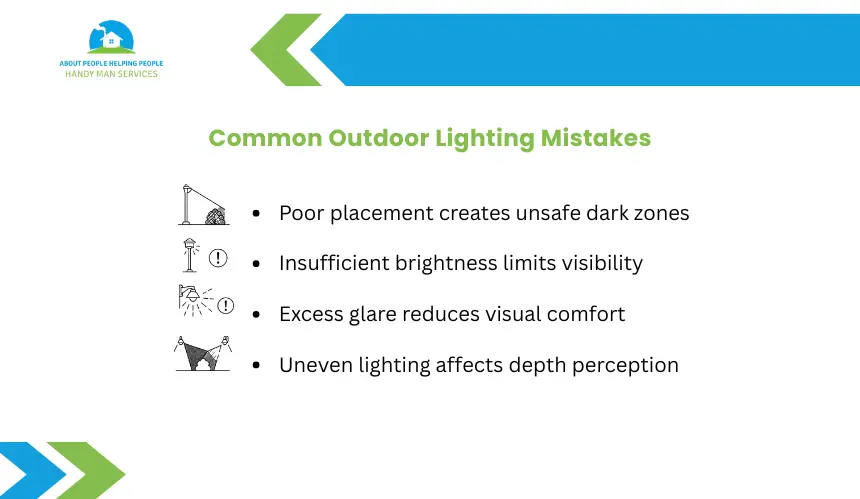
Outdoor lighting improves safety only when it is properly designed and implemented. Poor lighting decisions can create visibility gaps, visual discomfort, and a false sense of security, reducing the effectiveness of the entire system.
Poor Placement
Improper placement is one of the most common issues. Lights that are positioned too far apart or incorrectly angled leave dark zones where hazards and movement cannot be clearly seen.
This results in uneven visibility, with some areas well-lit while others remain in shadow. These blind spots increase the risk of accidents and reduce overall situational awareness.
Did you know? Even well-powered lighting can fail to improve safety if it is not positioned to cover critical areas effectively.
Insufficient Brightness
Lighting that is too dim does not provide enough illumination to improve visibility. Low brightness levels make it difficult to distinguish edges, obstacles, and movement, especially in larger outdoor spaces.
Insufficient lighting reduces the ability to navigate safely and detect terrain changes or activity, thereby limiting the system’s overall benefit.
Over-Lighting And Glare Issues
Excessive brightness can be just as problematic as insufficient lighting. Over-lighting creates glare, which interferes with the eye’s ability to adapt and perceive surrounding areas.
When glare occurs, it reduces contrast and makes darker areas appear even less visible. This creates visual imbalance and can increase the risk of misjudging distances or missing hazards.
Frequently Asked Questions
How does outdoor lighting improve home safety at night?
Outdoor lighting improves safety by increasing visibility, reducing shadows, and helping identify obstacles such as steps or uneven surfaces. It also improves awareness of surroundings, allowing quicker response to movement or potential hazards in low-light conditions.
What type of outdoor lighting is best for security?
Motion sensor lights and floodlights are most effective for security. Motion lights respond instantly to movement, while floodlights provide wide-area illumination, reducing dark zones and improving visibility across larger outdoor spaces.
Where should outdoor lights be installed for maximum safety?
Outdoor lights should be installed near entrances, walkways, driveways, stairs, and perimeter areas. These locations are critical for navigation and visibility, helping reduce accident risk and improving detection of activity around the home.
Can outdoor lighting help prevent accidents?
Proper lighting reduces the likelihood of trips and falls by improving visibility of walking surfaces and elevation changes. Clear illumination allows better depth perception and helps individuals navigate safely at night.
Does outdoor lighting deter intruders?
Well-lit areas reduce concealment opportunities and increase visibility, making it harder for unauthorized activity to go unnoticed. Lighting also works with motion sensors and surveillance systems to improve detection.
How does lighting placement affect visibility and safety?
Lighting placement determines how evenly light is distributed. Proper positioning reduces glare and shadows, ensuring consistent illumination across important areas. Poor placement can create blind spots and reduce overall effectiveness.